Friday, June 26, 2009

Gordon Brown puts $100bn price tag on climate adaptation

climate change in Bangladesh

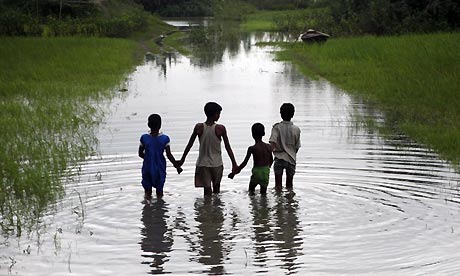
Flooding in Bangladesh: The annual $100bn falls well short of what developing nations have demanded in climate funding. Photograph: Hassan Bipul/DFID

Gordon Brown today attempted to seize the political initiative on climate change by calling for rich countries to hand over $100bn (£60bn) each year to help the developing world cope with the effects of global warming.

In a speech at London zoo, the prime minister said the cash offer was intended to break the political stalemate over a new global deal on greenhouse gas emissions. He said the "security of our planet and our humanity" rested on such a treaty being agreed at key UN negotiations in Copenhagen in December.

"Over recent years the world has woken to the reality of climate change. But the fact is that we have not yet joined together to act against it. Copenhagen must be the moment we do so," Brown said. "As always, this will involve a calculus of national and collective interests, with each yielding something for the common good."

Aides said the speech was intended to provide fresh momentum to the stalling political talks on global warming. In exchange for greater action on climate as part of a new deal, the developing world wants money to help it cut carbon emissions and adapt to a warmer world. Earlier this month, EU leaders postponed a decision on such funds until October.

Brown said: "If we are to achieve an agreement in Copenhagen, I believe we must move the debate from a stand-off over hypothetical figures to active negotiation on real mitigation actions and real contributions."

Under the plan, funding would begin in 2013 and rise to $100bn a year by 2020. The money would be raised from private and public sources, such as levies on international carbon trading schemes. Developing countries would be able to apply for funds for specific projects. "I would urge the leading developing countries to bring forward ambitious and concrete propositions ... that could be financed by these sources," Brown said.

Brown is expected to discuss the plan with world leaders including Barack Obama. Because the UK will negotiate at Copenhagen as part of the EU-bloc, the suggestion will have to be agreed in Brussels before it could be put forward as a formal offer as part of the Copenhagen negotiations.

The annual $100bn falls well short of what China and other developing nations have demanded in climate funding. The G77 group of nations has suggested that rich countries could hand over 1% of their GDP, a figure that British government sources consider unfeasible. "That's a totally unrealistic number. It doesn't even bring us to the negotiating table," one said.

Green campaigners welcomed the speech but were unhappy with the reliance on carbon markets to generate the necessary funds.

Greenpeace said: "Brown is right when he says the scale of the money on the table for the developing world will make or break Copenhagen. By becoming the first major leader to put a figure on how much money is needed he has shown signs of leadership on climate change that have so far been sorely lacking."

David Adam, environment correspondentguardian.co.uk, Friday 26 June 2009


Wednesday, June 24, 2009

Two Thirds of Americans Would Refuse to Give Up iPod - Even if it Ruined Environment

An astonishing new survey has revealed that more than 60% of Americans would refuse to stop using their iPods, even if they knew it was seriously damaging the environment.

The survey, which quizzed more than 1,000 people across the US, found that, whilst the majority of Americans are making efforts to buy greener products, most wouldn’t do so if it meant compromising on convenience or comfort.

Presented with a choice between comfort, convenience or the environment, 38 percent of those questioned said they’d choose their convenience, 36 percent comfort and just 26 percent the environment.

According to market researcher Suzanne Shelton, “Consumers don’t want to give up the modern conveniences of life. We’re all basically saying, ‘I’ll be green as long it doesn’t make me uncomfortable or inconvenienced.’”

» See also: Recycling In San Francisco Made Easy With The iPhone, by Mayor Newsom

In further findings, when asked, “If you thought these things were harming the environment, which of the following would you be willing to give up?” well under 50 percent of those polled were prepared to give up the following items:

  • iPod - 38 percent would be willing to do without it
  • Dishwasher - 35 percent
  • Microwave - 25 percent
  • Cellular phone - 21 percent
  • Air conditioning - 14 percent
  • TV - 13 percent
  • Computer - 7 percent
  • Car - 6 percent
  • None of the above - 21 percent
  • All of the above - 6 percent

Commenting on the findings Shelton said, “For most Americans, what once were considered conveniences have become necessities. That means the green movement has its work cut out for it: Convenience and comfort are big barriers for consumers going green.

“It means a lot of people simply won’t take on green projects, or buy a green product if they have to go to a different store to find it or if it somehow takes away from their personal comfort.”

by Andrew Williams

Monday, June 22, 2009

Madascar: Daewoo's Rainforest land grab in Natures Paradise

The island of Madagascar is a veritable Noah's Ark of biodiversity, and this natural wealth is the country's primary treasure and opportunity for future ecologically sustainable development. The Korean company Daewoo Logistics intends to lease half the agricultural land in Madagascar for 99 years, industrially producing maize and palm oil on 1.3 million hectares that are now biodiversity rich rainforests and gardens. There already exists a severe food crisis nationally and local peoples, who are soon to be dispossessed from their land, are protesting, causing a major government crisis. Tell Daewoo the people of Madagascar have spoken -- and to shove off and leave Madagascar's rainforests, peoples and land alone.

By Rainforest Portal, a project of Ecological Internet

Fate of Whaling Ban Hangs in the Balance as Pro and Anti-Whaling Countries Face Off

We'd like to think of whaling as an outdated practice, largely frowned upon and done only by a handful of persistent nations around the world. And so it is, for the most part--whaling has declined dramatically over the last 20 years. But all that could change. The International Whaling Commission is meeting in Portugal, and the focus of the conference is likely to revolve around the increasingly contentious worldwide whaling ban that was adopted by the IWC in 1986. Nations that still actively engage in whaling, led by Japan, Norway, and Iceland, are leading the charge to keep whales off endangered species lists--and for a full on return to legal whaling.
Read more
by Brian Merchant, Brooklyn, New York on 06.22.09
Human alteration of Earth is substantial and growing. Between one-third and one-half of the land surface has been transformed by human action; the carbon dioxide concentration in the atmosphere has increased by nearly 30 percent since the beginning of the Industrial Revolution; more atmospheric nitrogen is fixed by humanity than by all natural terrestrial sources combined; more than half of all accessible surface fresh water is put to use by humanity; and about one-quarter of the bird species on Earth have been driven to extinction. By these and other standards, it is clear that we live on a human-dominated planet.